

On August 18, 2026, I stood inside Korczak Ziolkowski’s old studio at the Crazy Horse Memorial, looking up at a wooden loft where uniforms, drums, and a weathered banner reading “Fides et Justitia” have hung for decades. A few feet away, on a stone counter, sat a plaster bust of a mustachioed man in a bow tie, its base inscribed simply: “Charles S. Miller, 1858-1943, Leader of Mattatuck Drum Band for 50 years.” I hadn’t expected to find a piece of Connecticut history waiting for me in the Black Hills of South Dakota, but there it was, and it sent me back through nearly 150 years of story to understand how it got there.

A Band Older Than the Country Itself
The roots of the Mattatuck Drum Band reach back to 1767, when the Farmingbury Training Band formed in what is now Wolcott, Connecticut, making it one of the oldest continuously active fife-and-drum organizations in the nation. The unit passed through several names over the next century: the Training Band, the 10th Regiment Band, the Farmingbury Band, the Wolcott Drum Band, before Charles S. Miller and a group of East End Waterbury boys purchased its old equipment in 1881 and renamed it the Mattatuck Drum Band, borrowing the Native American name once used for Waterbury itself.
Miller had joined the drum corps at fourteen, in 1872, and would go on to lead it for fifty years, teaching more Connecticut boys to drum than perhaps anyone else of his era while keeping detailed personal journals of his life’s work from 1876 until his death in 1943.

An Artist Arrives in West Hartford
Around 1936, a Boston-born, self-taught sculptor named Korczak Ziolkowski settled in West Hartford. He was struck that the town had never memorialized its most famous native son, lexicographer Noah Webster, and proposed to carve a statue himself if the town would raise the funds. West Hartford’s contribution fell well short of his estimate, so Ziolkowski simply went to work anyway, carving a 32-ton block of Tennessee marble out of a borrowed trailer parked on the Town Hall lawn, often shirtless and in open defiance of local Blue Laws.

To bring ceremony to the project, Ziolkowski organized the Noah Webster Fife and Drum Corps, recruiting local schoolchildren to march and drum for the statue’s eventual unveiling. Building a corps from scratch meant he needed an experienced instructor, and there was no better-qualified teacher in the region than Charles Miller, the founder and fifty-year leader of the well-established Mattatuck Drum Band.
Ziolkowski sought him out directly and asked him to train the young drummers. Miller, by then well into his eighties, agreed, and he began making the roughly thirty-mile drive from Waterbury to West Hartford on a regular basis to fulfill that promise, no small commitment in an era when thirty miles per hour was considered speeding. What began as a practical arrangement, a sculptor in need of a drum teacher, quickly grew into something warmer as the two men spent weeks together shaping the corps side by side.

The Dedication and a Friendship Forged
On October 16, 1941, Noah Webster’s 183rd birthday, roughly 500 costumed citizens gathered for the statue’s unveiling. The Mattatuck Drum Band marched that day in Revolutionary-era uniforms, and the corps’ own records describe the two men becoming “fast friends” from that point forward, a bond between the sculptor and his wife on one side and the veteran bandleader on the other.
In gratitude for Miller’s decades of service and his personal mentorship of the young corps, the band asked Ziolkowski to sculpt a portrait bust of their leader. It was unveiled on February 15, 1942, timed to the 175th anniversary of the drum corps’ founding. Miller’s own words from that ceremony survive: he called the moment “a series of surprises,” marveling that at his advanced age he had “so many friends,” and said the memory of those “faces all radiant with hope, with good wishes and beauty” would stay with him “to the final end.”

Their friendship extended well past the formal tribute. The two men held “drum corps parties” at Ziolkowski’s home, ran drum-making sessions together in Miller’s barn, and once, in cold rain, the young corps surprised the aging bandleader with a birthday serenade for his eighty-fourth year.

A Corps Heads West
Miller died on March 14, 1943, five years before Ziolkowski would break ground on Crazy Horse. In November 1939, Ziolkowski had already received the letter that would redirect his life, an invitation from Lakota Chief Henry Standing Bear to carve a mountain memorial to Crazy Horse, because “the red man has great heroes, too.” After serving overseas during the war, Ziolkowski parted ways with West Hartford for good and, in 1947, loaded a caravan with drums, uniforms, and equipment, much of it heirloom material, and headed for the Black Hills.
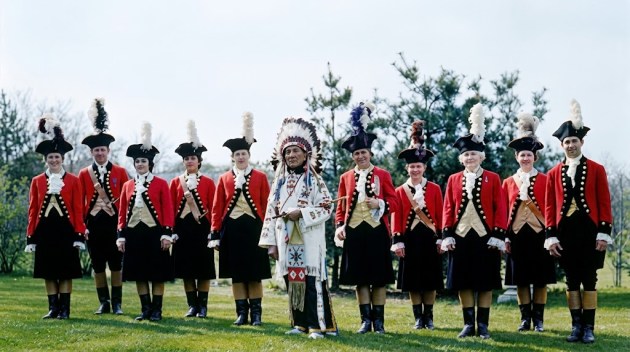
That equipment became the founding stock of South Dakota’s first Ancient fife-and-drum unit, renamed the Hill City Fife and Drum Corps. After a falling-out with the town of Hill City, Ziolkowski chose to reform the group under its original Connecticut name, marching once again as the Noah Webster Fife and Drum Corps, now through the mountains of South Dakota rather than the streets of New England. Eventually, the sheer physical demands of carving Crazy Horse made sustaining both projects impossible, and the corps was set aside, though those who knew Ziolkowski say he never gave up hope of reviving it.
Even so, he remained connected to that world for the rest of his life. At his death in October 1982, the Company of Fifers and Drummers listed him simply as “K. Ziolkowski, 74, Drummer, Noah Webster FDC,” and credited him with introducing South Dakota to the sound of Ancient fifing and drumming.

What Remains
Standing in that studio on August 18, 2026, I could see it all laid out physically: the drums stacked on their wooden shelves, several still painted with the words “Noah Webster Crazy Horse Fife & Drum Corps,” the years “1942” and “1943” marked plainly beneath them, and Charlie Miller’s plaster likeness watching over the room from its stone perch. It is a strange and moving thing to see a small-town Connecticut friendship, between a headstrong young sculptor and an eighty-something bandleader, preserved inside the workshop of what has become the world’s largest sculpture in progress.
Miller never lived to see Crazy Horse rise from Thunderhead Mountain. But the drums he taught a generation of children to play made the journey west without him, and nearly a century later, they are still there, quietly keeping time.


Recent Comments